Global Food Delivery Market: Growing by leaps and bounds amidst brutal competition
Online food delivery is the process of ordering meals using a website or smartphone applications. Online ordering and other low-cost purchasing options are becoming more popular among citizens around the world. Consumers value convenience the most, as placing an order on mobile devices such as smartphones, tablets, or laptops involves only a few clicks. The growing demand for quick access to food at low prices is also fueling the expansion of online food delivery services. Advantages provided by online delivery services include rewards & cash back incentives, tempting discounts, different payment options, and doorstep delivery.
In today's digital market setup, the market for online food delivery services is expanding rapidly. In 2020, the global online food delivery market was valued at USD 121.57 billion. Between 2021 and 2027, the industry is estimated to grow at a CAGR of 10.39%, reaching a market value of USD 189.07 billion by 2027.[1] According to Frost & Sullivan, a growth strategy consulting and research firm, the market was worth $82 billion in gross revenue bookings in 2018 and is expected to more than double by 2025.
Key Market Players
| Uber Eats | The most widely available food delivery service, active in six continents and first or second in gross orders in most countries |
| Just Eat | Leader of food delivery in the UK and active in Europe and Australia, also holds a stake in Brazilian food aggregator iFood |
| Grubhub | Original aggregator in the US and with Seamless, controlled over 50 percent of US online food delivery up until 2018 |
| Takeaway.com | A European aggregator responsible (through subsidiaries) for most online food delivery in Germany, Netherlands and Belgium |
| DoorDash | The current leader in online food delivery in the US, which also pioneered the platform-to-consumer model |
| Postmates | A subsidiary of Uber Eats since 2019, responsible for about 10 percent of online food delivery in the United States |
| Deliveroo | The pioneer of platform-to-consumer in the UK, it now operates in 13 countries, competing with Uber and Just Eat |
| Delivery Hero | Through its many subsidiaries (including Food Panda), Delivery Hero has a controlling interest in food delivery platforms in over 40 countries |
| Ele.me | Owned by Alibaba, Ele.me is one of the two major food delivery platforms in China. It has over 200 million active users |
| Jumia Food | Part of the African e-commerce giant Jumia, which was the first African startup to be valued at over $1 billion |
| Damae-Can | Japan’s first choice for takeout, Damae-Can has over 20,000 restaurants and 2.3 million active users |
| iFood | Brazil’s most popular aggregator by a significant margin, accounting for over 70 percent of online takeaway orders in the country |
| Zomato | The most popular of the homegrown food delivery apps in India, which acquired Uber Eats India in January 2020 |
| Yandex.Eda | As Uber is not active in Russia, Yandex.Eda has been given free reign to all of the platform-to-consumer market |
Table-1: Key food delivery platforms across the globe
Source: CB Insights
Market trends
The COVID-19 delivery boom: As a result of the coronavirus pandemic, revenue for the to four U.S. delivery apps (Doordash, Uber Eats, GrubHub, and Postmates) increased by $3 billion in the second and third quarters of 2020. While the firms are experiencing increased revenue, their costs are still too expensive to sustain a profit. Other stakeholders, such as restaurants and drivers are attempting to either limit the fees that companies are permitted to charge or obtain a fair part of the companies' income. In the short term, many restaurants have little choice but to use the food delivery applications. But it's unclear how long the rise in deliveries will endure, and what it means for the long-term financial success — or failure — of food-delivery apps.
Increase in investments: Food delivery companies are the next investment hotspot, with investors wagering that demand for food delivered to homes and workplaces would continue to expand. According to PitchBook, venture capital companies have invested $3.5 billion in food and grocery delivery services so far in 2018, which is more than triple the amount they invested in all of 2017. After obtaining its last round of funding in August 2018, DoorDash Inc. was valued at $4 billion, the same as Wendy's Co., the world's third-largest hamburger chain, whose burgers it delivers.[2] The $1.3 billion IPO of Indian food delivery startup Zomato is the most recent illustration of this sector's investor enthusiasm. Zomato's stock offering, which was more than 38 times oversubscribed, garnered bids worth $46.3 billion, indicating that investors were bullish on the fast-growing sector.[3]
Cloud kitchen and subscription based models- new verticals: After 2020, corporations' priorities have shifted, and instead of enticing customers to "Buy Two, Get One Free," they are now focusing on becoming more human to them. This is why subscription-based food delivery services are in demand. Businesses are increasingly turning to the idea of selling things in exchange for recurring subscription revenue, which can be paid monthly or annually. Customers and company owners can subscribe to a plan with a one-time payment that meets their needs and matches their budget. There is no need to pay for a single item each time, and in exchange, one can gain recurring value. All of this means that companies can create an app for users and business owners on either iOS or Android. Food delivery businesses that use a subscription-based business model have a better chance of retaining consumers and getting them to order again. Since 2014, digital ordering has risen three times faster than dine-in traffic. As a result, the number of cloud kitchens is rapidly increasing. The concept of cloud kitchen allows restaurants to save money, making it a desirable business model especially during a pandemic like COVID-19. Cloud kitchens, according to a recent EuroMonitor analysis, may create a $1 trillion market. There are over 1,500 cloud kitchens in the United States alone, with the United Kingdom having 750, China having 7,500, and India having close to 3,500. Restaurants can use third-party systems like Kitchen United and Kitopi to try out cloud kitchens. Across the United States, investors are pouring millions of dollars into these cloud kitchens.[4]
Issues making the market brutal
Although the trends mentioned in the previous suggest an optimistic view of the global online food delivery industry, the reality is the market is brutal. Some issues make the market a war field among the competitors.
Despite large revenues and investments, food delivery companies continue to struggle with profitability, owing to significant capital burn rates. Predatory pricing is a common method for beating the competition in which businesses accept a loss on a transaction by heavily subsidizing the meal's cost. Because these services are outsourced, they have little control over logistical reliability or product quality. If a customer is dissatisfied with either of these aspects, the online food company is responsible for the financial consequences. Lastly, fraud is becoming an increasingly critical concern hurting the industry, whether it's through restaurant orchestrated "ghost" deliveries or cybersecurity flaws associated with digital payments.
As a result of these tendencies, numerous businesses have closed due to inability to endure the heat in the kitchen. Munchery, a U.S based company, shut down its operations in 2019 after obtaining more than $120 million in funding due to a high capital burn rate and overly ambitious expansion ambitions that failed to attract fresh investors. And, most recently, Amazon Restaurants ceased its operations due to fierce competition and an inability to expand its market share in the United States.[5]
Bangladesh Food Delivery Market: Abounding with prospects
In Bangladesh, a culture has developed in Dhaka and a few other major cities in which digital residents can order food from reputable restaurants and home-based companies and have it delivered to their doorsteps by just swiping their fingers across an app. Online food delivery market in Bangladesh, especially in Dhaka, has seen an unexpected growth, thanks to technological advancement and change in lifestyle. Online food deliveries allow inhabitants of Dhaka to search for and find nearby restaurants of their choice, as well as place orders on their behalf.
HungryNaki, a local start-up, which launched in 2013, was the first to provide such online food delivery services in Bangladesh. Later on, a number of other companies, including a few global ones, joined the venture. Although global ride sharing company Uber launched its food delivery platform Uber Eats in Bangladesh in April 2019 and soon gained popularity with its solid service.
Currently, four companies including Foodpanda and Pathao Food, control 90% of the market, with a few others holding the remaining 10%.[6] Until now, the food delivery business has been concentrated in Dhaka and a few cities such as Chittagong, Sylhet, Cox's Bazar, and Narayanganj. According to projections, the current market size for food delivery is $10 million, with the potential to rise to over $5 billion by 2025.[7]
Trends suggest bullish scenario
The following trends are persisting in the online food delivery industry in Bangladesh like elsewhere across the globe. These trends suggest that the market is in a bullish phase.
- Increase in demand due to COVID-19: Lockdowns imposed due to COVID-19, introduced many Bangladeshis to online services such as e-commerce stores and telemedicine services. Online food delivery platforms also got a boost in sales as more and more people locked in their households started ordering through these platforms. One newspaper reports estimates orders through these platforms increased by 15 to 20 percent from pre-pandemic levels since the first lockdown in April 2020.[8]
- Rise in local and foreign investment: Investors, both local and foreign, are continuing to pour money into Bangladeshi food delivery platforms. Ride sharing app, Pathao, which is the market leader in the food delivery industry, received an undisclosed amount of grant from Startup Bangladesh Limited in March 2021.[9] In the same month, Chinese e-commerce giant Alibaba acquired HungryNaki for an undisclosed amount. Previously, Singapore based Golden-Gate Ventures led a USD 15 million round for Shohoz.[10] The increase in investment testifies to the fact that the food delivery industry in Bangladesh is a bullish case.
- Launch of new products: Food Delivery companies are also increasing their product lines. HungryNaki launched a full Qurbani service last year where it offers selection, slaughter, and even cooking services of goat for sacrifice during Eid-al-Adha. It continued the service this year as well. On the other hand, FoodPanda launched PandaMart last year that provides groceries and other essentials delivery services.
Growth Potential bolsters case for bullish scenario
Although online food delivery in Bangladesh started off back in 2013, it still remains in its early stages. There are still more markets remaining to be tapped in order to unlock the industry’s full potential. The untapped potential supports the bullish hypothesis we have made in the previous section and makes the Bangladeshi market more attractive than the global one. We believe more potential for this industry due to the following two reasons:
1. Stronger future economic growth: The World Bank forecasted Bangladesh’s GDP growth at 5.1 percent for FY 2021-22 and 6.2 percent for FY 2022-23. Pre-COVID, GDP growth stood at 8 percent.[11] Given increased demand for export oriented sectors such as RMG, Pharmaceuticals, IT outsourcing; strong domestic consumption, and Bangladesh’s graduation from LDC status, we expect GDP growth to recover back to pre-COVID levels and even above.
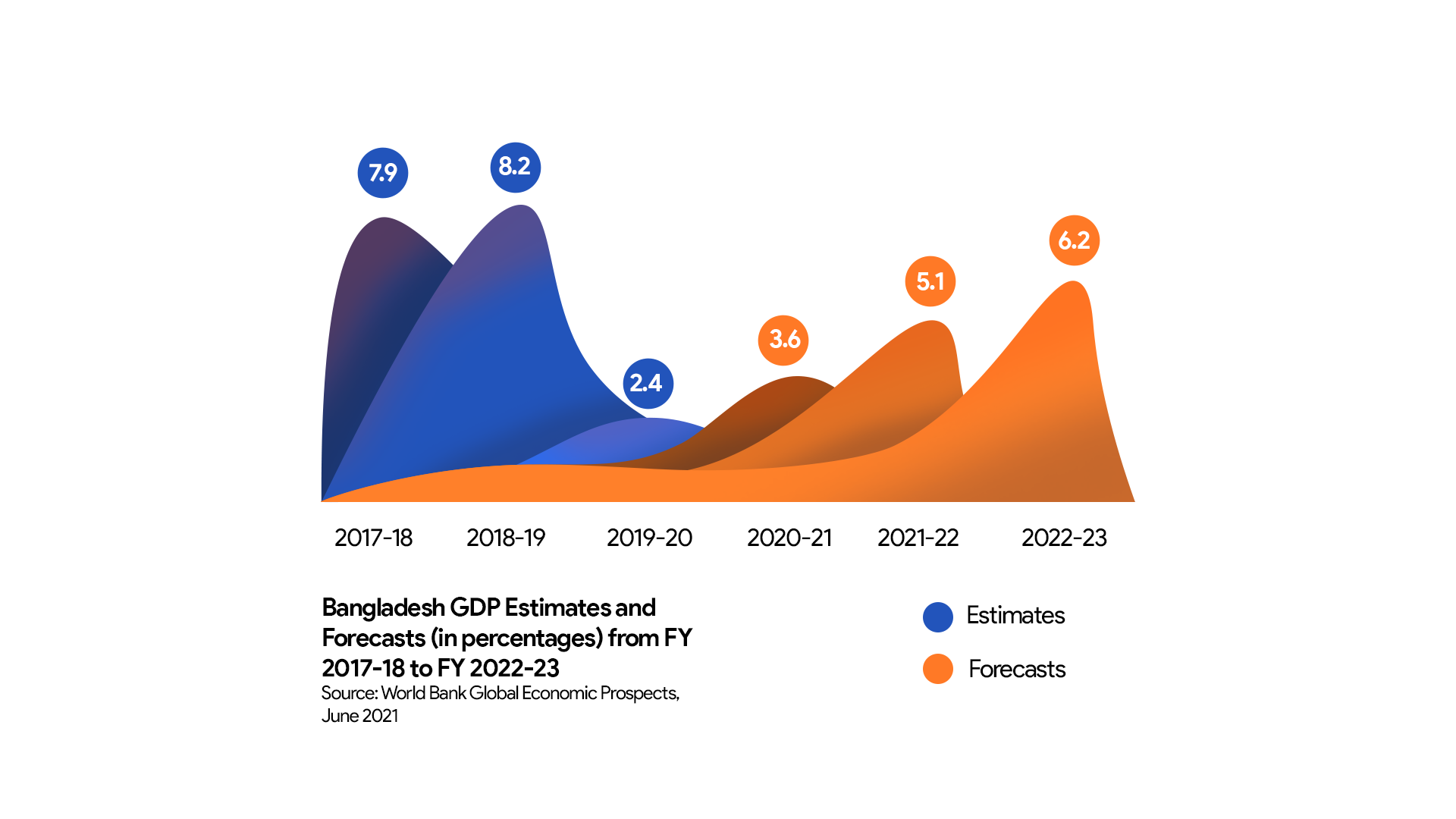
The increased economic growth will lead to greater employment and migration to urban areas. Purchasing power will increase and people will prefer to use food delivery platforms more, which will lead to greater demand.
2. Increasing Internet penetration: Internet penetration rate in Bangladesh is around 70 percent as per BRTC data. It is mainly concentrated in Dhaka, Chattogram, and Sylhet cities. So most food delivery platforms operate in these cities only. The exception is FoodPanda that has recently expanded to all districts.
Number of internet subscribers at end of year (in millions)/ Source: BRTC | |
Year | Number of internet subscribers (in millions) |
| 2015 | 54.12 |
| 2016 | 66.62 |
| 2017 | 80.48 |
| 2018 | 91.35 |
| 2019 | 99.43 |
| 2020 | 111.88 |
| 2021 (till May) | 117.31 |
Table-3: Number of internet subscribers at end of year (in millions)
Source: BRTC
As the rate is still not 100 percent, there is still scope for the internet to penetrate in Tier-2 and Tier-3 cities. Spread of the internet in these cities coupled with economic growth will create a demand for food delivery and thus increase the market size for these platforms.
High Competition making companies leave market
The market size for online food delivery is still small. So platforms need to fight over a small piece of pie. This has led to cut throat competition where the platforms need to make heavy investments to grow and increase market share.
Although heavy investments mean burning a lot of cash, it does not necessarily result in higher market share. Thus, platforms are stuck with the same market share and continue to incur losses. Ubereats’s operations in Bangladesh is an example of the aforementioned situation. It suspended its operations in June last year. No reason was provided by its parent company. However, it is believed that the suspension was part of Uber CEO Dara Khowsrowshahi’s cost cutting measures to divest from operations where it cannot be a market leader.
Ubereats suspended operations right after the countrywide lockdown ended. The lockdown should have resulted in Ubereats gaining more revenues and perhaps even greater market share. But it's suspension as a result of it not being able to be a market leader suggests cut throat competition in the industry.
The debate on discounts- profit harming or growth supporting?
Delivery platforms subsidize orders by providing discounts. This practice has often been highly criticized. Critics argue that although discounts onboard customers to the platform, it is not effective in retention. Once giving discounts is lifted, customers will switch to another platform. Food delivery platforms will therefore need to continuously provide discounts in order to retain customers.
Insiders provide a different view. One executive of a top food delivery platform in Bangladesh interviewed by Shubhankar Consulting shares a new perspective. According to him, food delivery platforms try to see the lifetime value they can obtain from each customer. In order to increase the lifetime value, they need to keep the customers engaged in the platform. So to engage customers, platforms need to offer discounts. Once the customer is engaged well enough, they will not require discounts anymore.
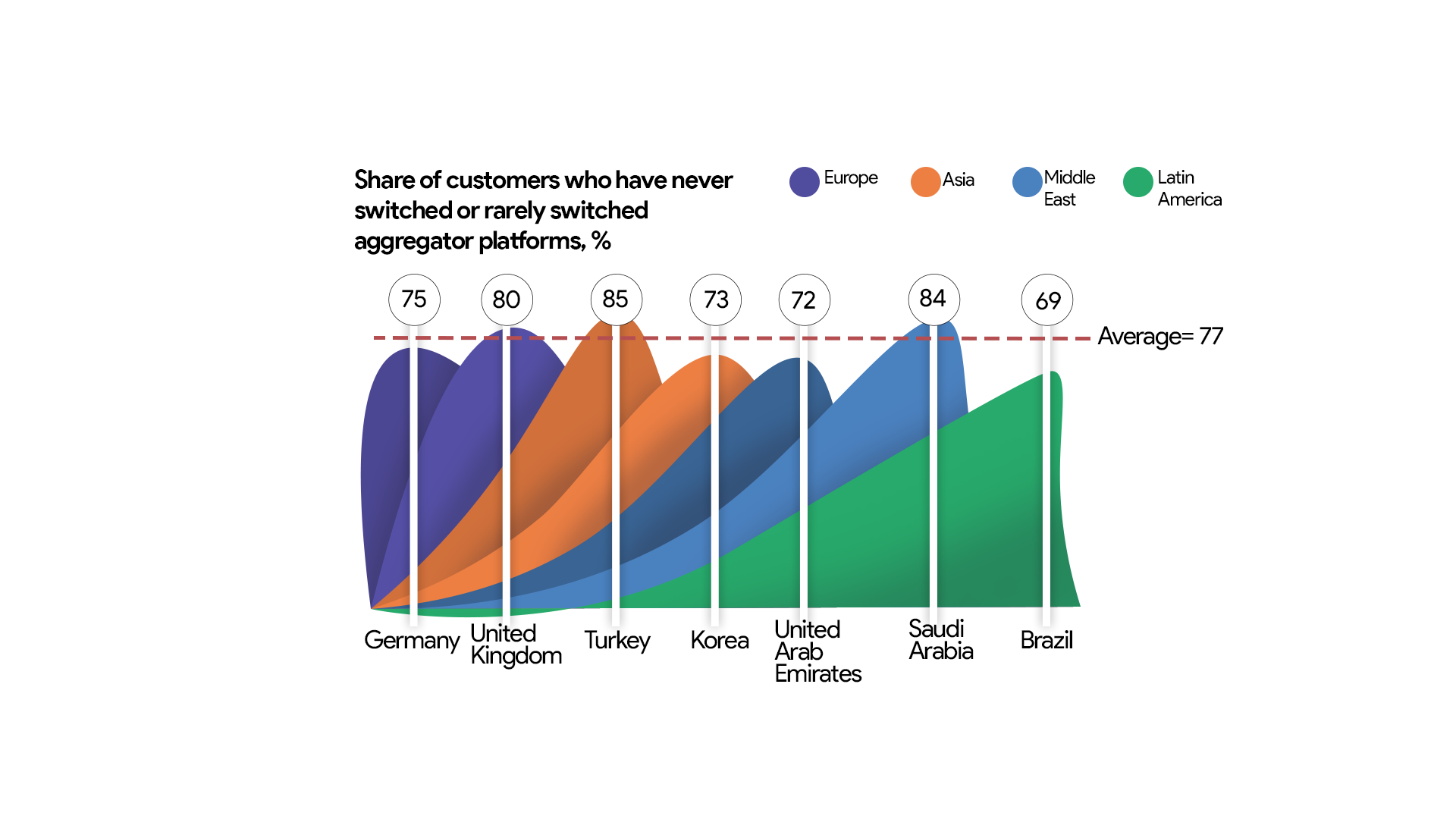
Data seem to support the view of the executive more than those of critics. One study by McKinsey in 2015 shows that consumers in seven countries across four geographies tend to stick to the food delivery platform rather than to switch to another one. Although one might exhibit caution in generalizing the finding across time and other countries as well.
The executive elaborated his stance stating that food delivery platforms are startups and every startup sees customer transactions as a chance for growth and not profit. The startup’s job is to scale and turn each customer into a lever of profitability. Since the food delivery market in Bangladesh is still not mature enough, there are still opportunities left for these platforms to expand, scale, and become profitable in the future.
The road ahead: Increase market size and offer discounts smartly
As the food delivery market is still not large enough, it is not easy to say that food delivery platforms are not being profitable. Increasing market size can help increase revenue and in turn improve profitability for these companies.
At the same time, companies must employ discounts smartly. Critics’ observation of discounts still holds merit. So platforms should not arbitrarily give discounts but offer them when they see the lifetime value of customers will increase if given.
The combination of increased market size and smart discounts seem to help food delivery companies to be profitable. One study by HSBC shows that post-COVID, Indian food delivery companies will achieve positive EBITDA due to higher average order value and lower discounts.
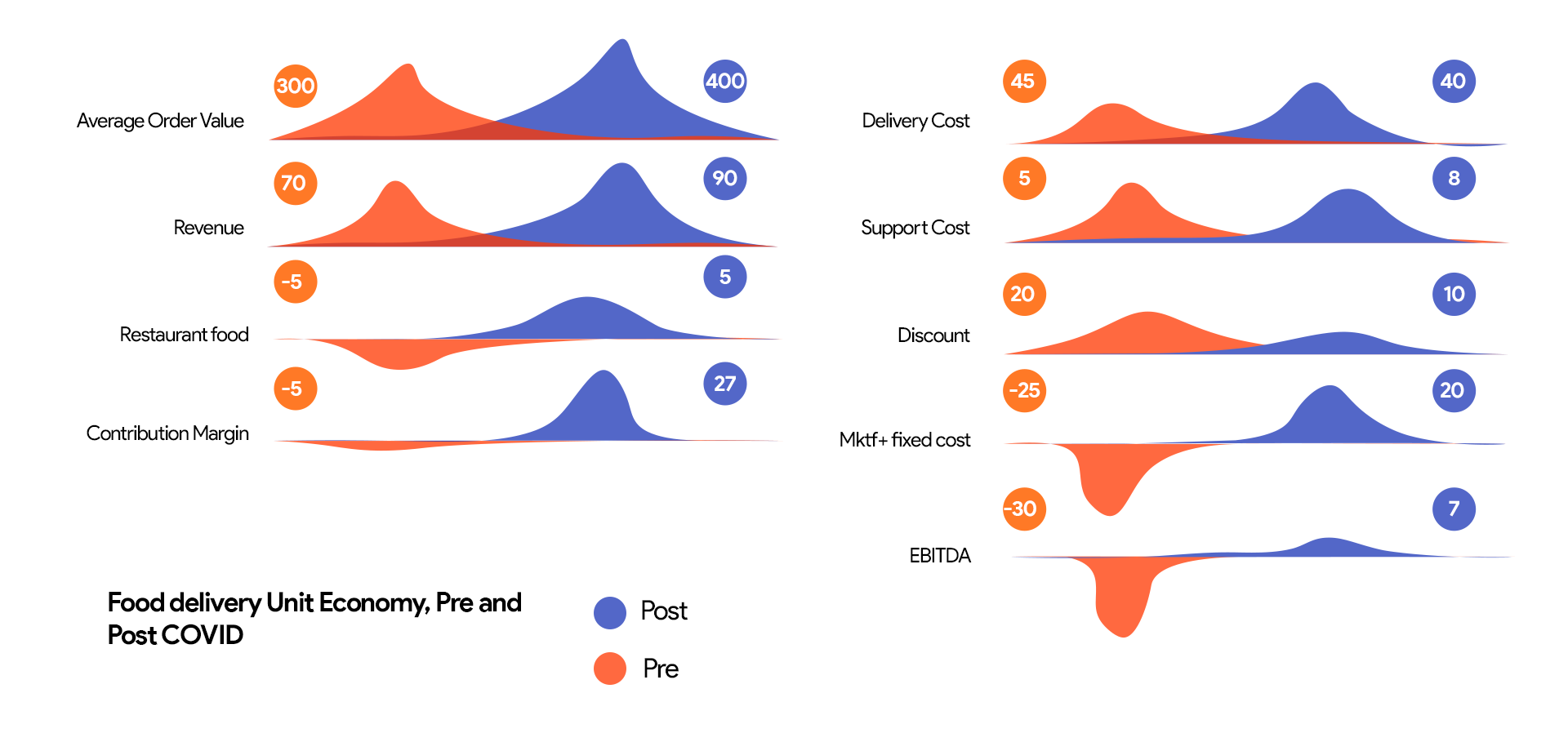
Bangladeshi food delivery platforms can take note of this finding to achieve positive unit economics. This will help them scale faster and achieve profitability. Average order value can be increased by tapping more markets. With the increase in economic growth in the country, companies will be able to achieve this. On the other hand, platforms can deploy discounts smartly using analytics, gamification (e.g. point based rewards), and loyalty programs.
References
1. Online Food Delivery Market: Global Industry Analysis 2015 To 2020 And Opportunity Assessment 2021 To 2027- Brand Essence Research
2. Investors Are Craving Food Delivery Companies- The Wall Street Journal
3. Investors Lap Up Food Delivery Company Zomato's IPO With Bids Of $46.3bn- Hospitality Ireland
4. Cloud Kitchens: Will This Concept Catch Up In 2021?- Blink Co Technologies
5. The Soon To Be $200B Online Food Delivery Is Rapidly Changing The Global Food Industry- Forbes
6. Meteoric rise of online food business- Dhaka Tribune
7. The State of Online Food Delivery in Bangladesh at The Beginning of 2020: Subsidies Make True Demand Hard To Gauge- Future Startup
8. Lockdown a boon for online food delivery services- The Business Standard
9. Pathao- Recent News & Activity- Crunchbase
10. Alibaba buys Bangladesh food delivery service HungryNaki- Nikkei Asia
11. Global Economic Prospects June 2021- The World Bank Group