Bangladesh is all set to welcome Investors:
Bangladesh has been marching towards developing an investor-friendly environment including up-gradation of existing special economic zones (SEZs) and export processing zones (EPZs) alongside the development of new SEZs and EPZs with an aim to make the number 100 (i.e., 100 SEZs and EPZs in total).
One of the vital reasons for this economic expansion in Bangladesh has been driven by the stable macroeconomic conditions. The country has been perceived as a persistent economic growth with expanding industries of electricity, telecommunication services, and transport. One of the lucrative resources of Bangladesh is the rapidly growing labor population along with a lower growth rate the population. This has further enhanced the productivity level of the labor force.
Bangladesh has been predicted to be one of the fastest-growing economies by 2050 with a position of 23rd largest economy from its current 43rd position. The country has invested considerable resources to ensure macroeconomic stability while investing in mega projects to improve its infrastructure and substantial measures have been taken to expand its financial sector and enhance its international trade. This ensures endless opportunities for Bangladesh to ensure her sustainable economic growth.
Robust Growth of the Country
Bangladesh has ensured a sustainable rising economic growth that can be evaluated with constant rising annual growth of Gross Domestic Product. This has paved its way to being a profitable hub for investors (both local and foreign) to set up their enterprises and harvest the benefits through the proper utilization of all resources. The country’s impressive sustainable growth strategy could be perceived with its resilience of having a remarkable GDP growth rate amid the pandemic with 5.2% in 2020 as per the statistics provided by the Asian Development Bank (ADB). This is the highest growth rate in the South Asian Region which is followed by Bhutan with a 0.9% increase in their GDP. Other countries in the South Asian Region have seen a negative GDP growth rate in 2020 and were unable to adapt to the sudden shock of the pandemic and businesses have to suffer from this fall in the economy. This portrayed Bangladesh’s adaptability and perseverance attributes which is an ideal economic condition for setting up their business.
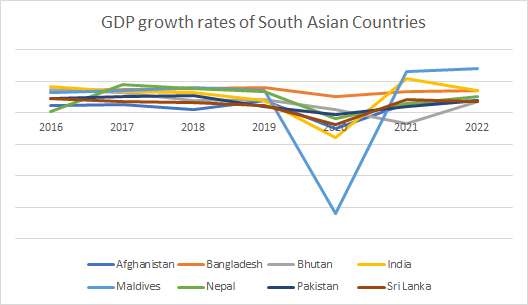
The factors behind this illustrative growth in GDP can be linked to rising consumption level with public investment, recovery of ready-made garments (RMG) sector resulting in better Balance of Payments, and high remittance growth. Albeit in the pandemic all the sectors have seen a decline which is inevitable due to an ongoing worldwide pandemic that has a pervasive impact. Despite this uncertain condition in the economy, the country has experienced a growth in its remittance inflow from $14.9 billion in 2015-16 to $18.21 billion in 2019-20.
The domestic market growth has also been complemented by investment in strengthening the country’s infrastructure. For instructional development, the list includes various mega projects, such as Padma Bridge, Metro Rail, MRTand the Kurnaphuli Tunnel along with a good number of other projects all around the country. These investments are likely to further expand the economic growth of the country which ensures a rise in domestic consumer demand with mitigating costs for business through a smoother supply chain. The government has also taken initiatives through strengthening multilateral ties with India, Bhutan, and Nepal that were further bolstered with the formation of an alliance with China of developing the regional Asian Highway and the “One Belt-One Road” initiative. This connection will prompt more investments and global collaboration.
Rising Standard of Living
The rising potential of the Bangladesh market can be linked to the rising living standards of individuals. The measurement that could be used to assess the living standards of individuals in the country could be the GDP per capita which has increased over the years as shown in Figure 1.2.
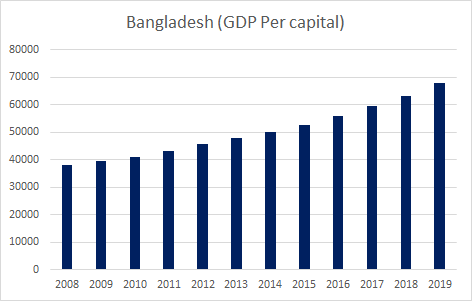
Overall, rising GDP per capita indicates the rising in individuals' living standards in our country, which ensures that the domestic market has the potential to expand more with the rising labor force. It makes the Bangladesh market suitable for businesses to set up. The trends of the current consumption level are expected to rise which will be the key indicator of the country’s economic growth. Hence the rising demand will expand the needs of the consumers to demand high-quality products.
Stability of Inflation
Inflation is one of the key macroeconomic indicators while the stability of the Inflation rate is one of the government's macroeconomic objectives of Bangladesh. The same objective has been set by various countries to ensure that their citizens' purchasing powers do diminish and that will have an adverse impact on individuals living Standards. In a similar context, stability of the inflation rate indicates certainty for businesses that will allow them to take articulate decisions to ensure better returns for their stakeholders. Hence, stability in inflation rate stability is a prime signaling tool about rising costs and the demand pattern of consumers.
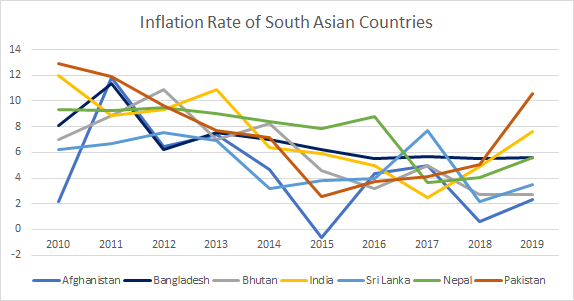
Bangladesh has a relatively stable inflation rate at an average percentage of 5.58% from 2016-19. It has one of the stable inflation rates in the context of all the South Asian Region Countries. The inflation rate in 2017 and early 2018 seemed to have increased which was due to the low food production and weak management of resources.
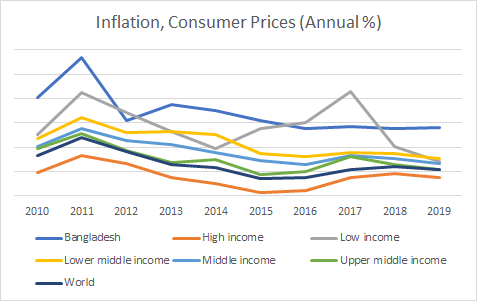
Albeit, implementing impressive BORO harvest and rice-wheat imports had alleviated the inflation rate by 6%. Following that we can conclude a downward trend in the inflation rate of the country, which has been constant. Amid the pandemic, the country has been able to maintain its stable inflation rate of 5.65%.
Even after comparing the inflation rate with countries that are in different income groups, we can perceive a stable inflation rate in Bangladesh which has been declining similar to middle-income countries.
Demographic Dividend
More than half of the total population of Bangladesh is employable and about 70% of the total population is within the age range of 15 years to 64 years in Bangladesh. This has provided the country with a unique opportunity for an active and employable population; so, any investor can assure that they will have no problem in getting an adequate number of employees in her/his enterprise(s) to run the business.
Besides, Bangladesh has been a country with a rising skilled labor force, that has been achieved through different government initiatives and a collaborative approach of different traditional educational and non-traditional educational institutions to enrich and develop its human resources for the dynamic world. Despite its rising labor force, it has perceived a lower population growth rate of 1.042% in 2019, which seemed to have further decreased in 2020. The current population of Bangladesh has reached a level of 167 million.
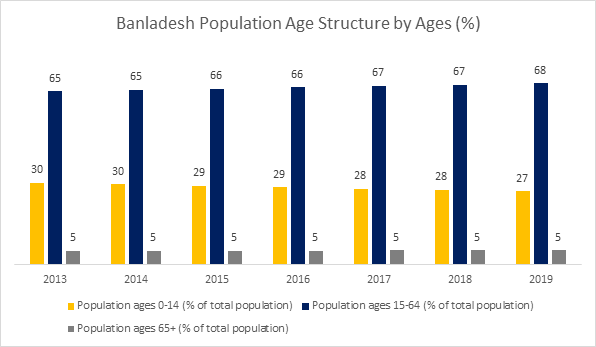
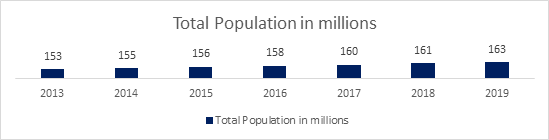
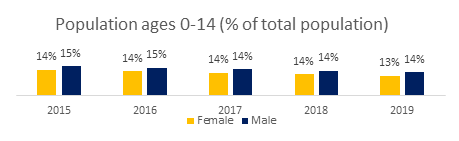
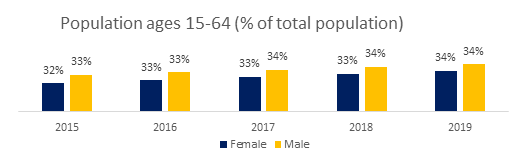
Bangladesh has been experiencing a rise in its working force which enables businesses to have a wide pool of potential who can unleash their caliber and with adequate training, they can efficiently perform on global platforms.
So, it’s the turn of the investors to invest and grow with Bangladesh.