Analyzing Bangladesh-China Economic Relationship: Defining trends and future prospects
Trends defining the Sino-Bangladesh economic relationship
Bangladesh and China officially recognized each other in 1975. Since then both countries have maintained a close economic relationship. Today, the relationship is expressed by the increasing trade between the two countries, the high amount of FDI inflow in Bangladesh, and Bangladesh’s participation in China’s Belt and Road Initiative.
Increasing trade relationship
The two countries have been in a historic trade relationship since the days of the ancient silk road. Today, China is Bangladesh’s largest trading partner. Trade between the two nations in FY 2019-20 stood at USD 12 billion.[1]
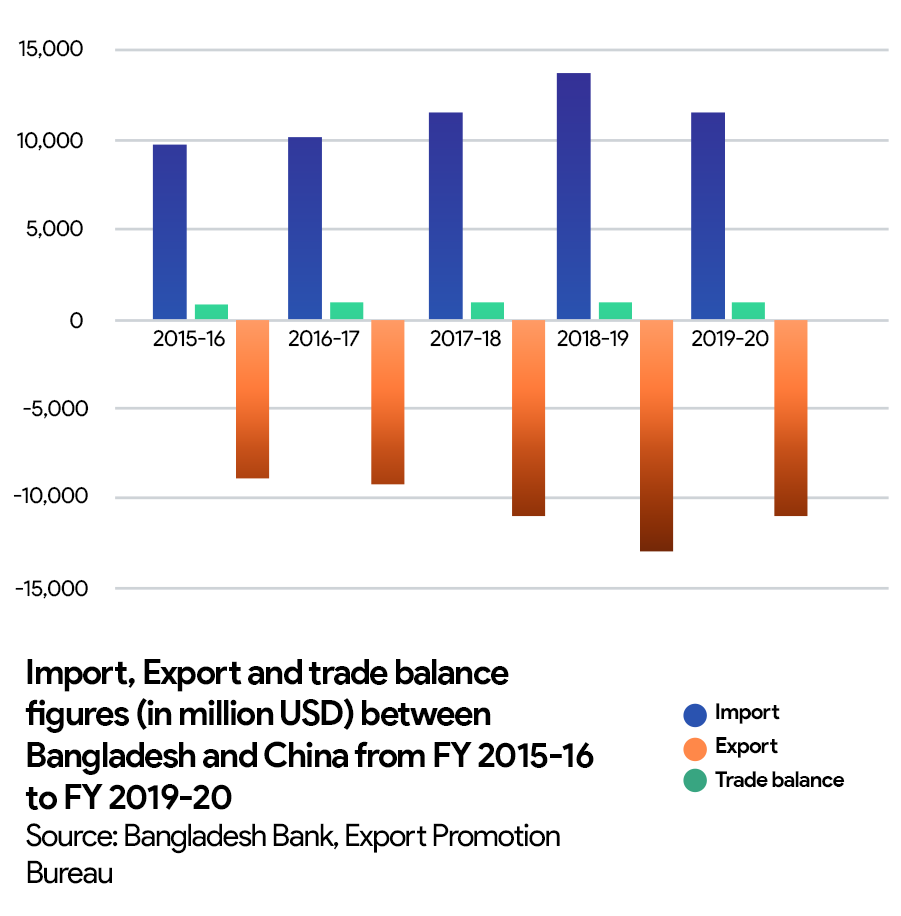
China remains Bangladesh’s main import source comprising 31.1% of total imports in 2019. Bangladesh mainly imports nuclear machinery, cotton, electrical equipment, man-made staple fibers, and knitted or crocheted fabrics. On the other hand, exports to China made up 2.17% of Bangladesh’s total exports in 2019. Bangladesh exports textiles, animal hides, foodstuffs, animal products, and leather goods.[1]
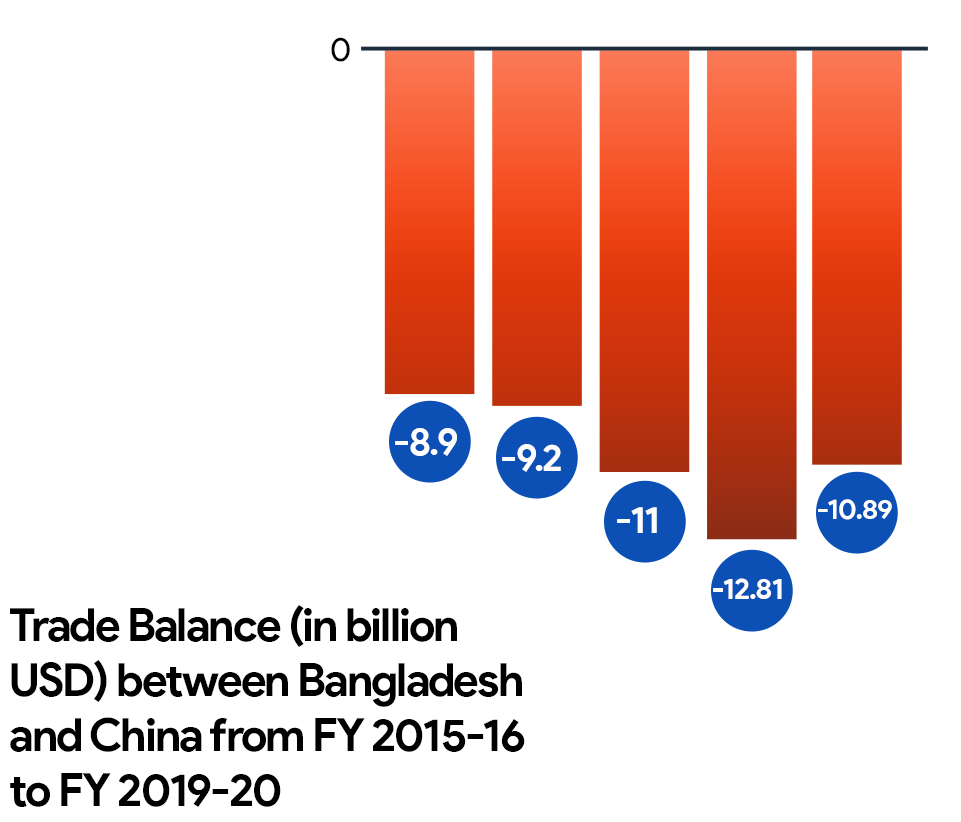
Despite rising imports, exports have not grown much. As a result, the trade deficit continues to increase. The situation may improve in the future as China has exempted tariffs for 97% of Bangladeshi products last year. The exemption brings a total of 8,256 products made in Bangladesh under duty-free treatment.[2] It is expected that the duty-free access will increase exports to China and reduce the trade deficit.
The two countries are also working to sign a Free Trade Agreement (FTA) between them. Experts estimate the FTA will increase Bangladesh’s exports to China by 25% and imports by 16%.[3]
Rising Chinese FDI inflows into Bangladesh
China is the top source of Foreign Direct Investment (FDI) in Bangladesh. The years 2018 and 2019 saw record amounts of FDI from the former into the latter.
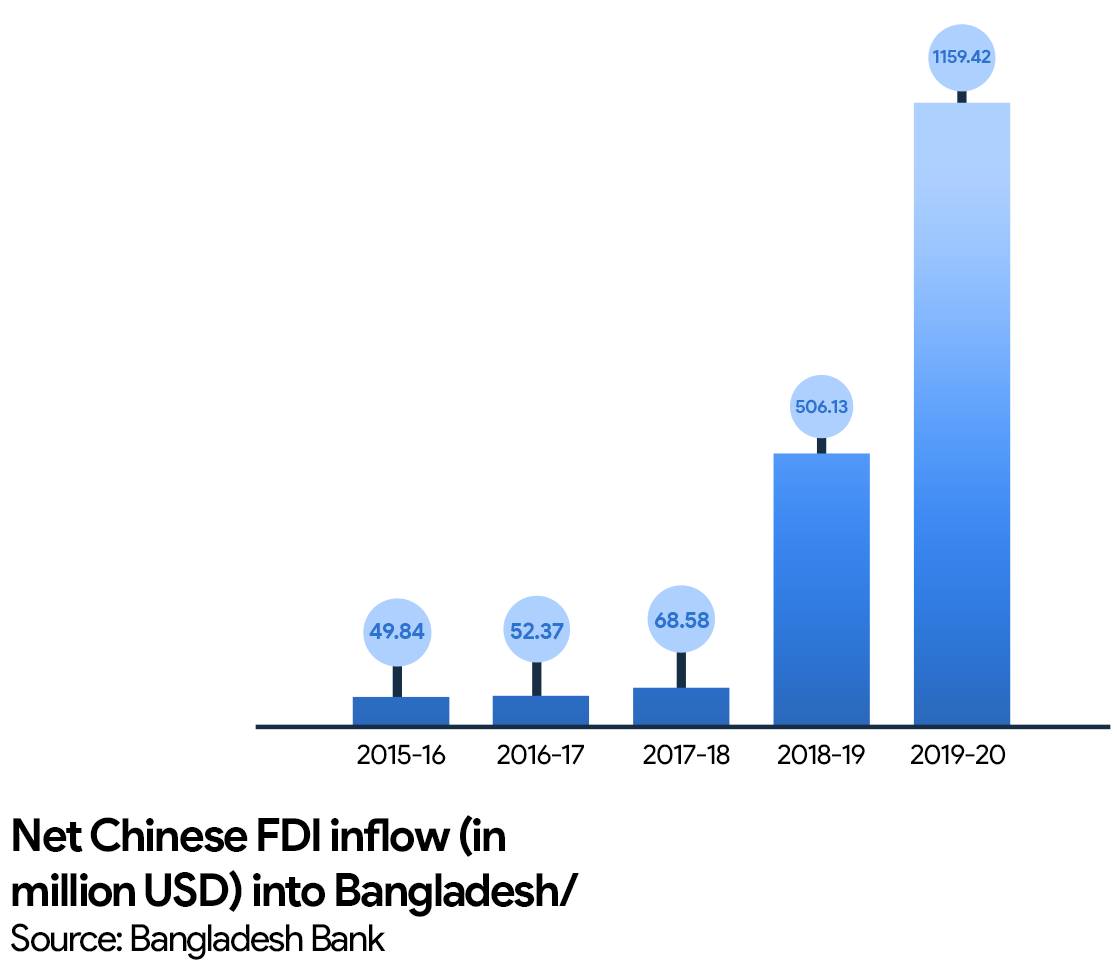
The world’s second-largest economy has been investing in Bangladesh both at the government-to-government (G2G) level and business-to-business (B2B) level. G2G investments have been part of the Belt and Road Initiative (discussed in the next section). At the B2B level, investments have been made in the textile, financial services, and technology sectors. Notable private investments include:
- Consortium Shanghai and Shenzhen stock exchange’s acquisition of 25% stake at Dhaka Stock Exchange (DSE).
- Ant Financial Service’s acquisition of 20% stake at bKash- Bangladesh’s largest Mobile Financial Service (MFS).
- Alibaba’s acquisition of Bangladesh’s largest e-commerce company- Daraz and a leading online food delivery company- HungryNaki.
FDI in various sectors continues to grow despite the pandemic. Back in December of last year, China Civil Engineering Construction Corporation (CCECC) and Jeihong Medical Products (BD) have together invested USD 28.69 million (BDT 244 crore) to set up plants at the Bangabandhu Sheikh Mujib Shilpa Nagar (BSMSN).[4] In March of this year, another Chinese company Vanessa Enterprise signed a USD 41.77 million deal with Bangladesh Export Processing Zones Authority (Bepza) to produce ladies’ accessories in the Ishwardi export processing zone (EPZ) in Pabna.[5]
Meeting Bangladesh’s infrastructure needs through the Belt and Road Initiative
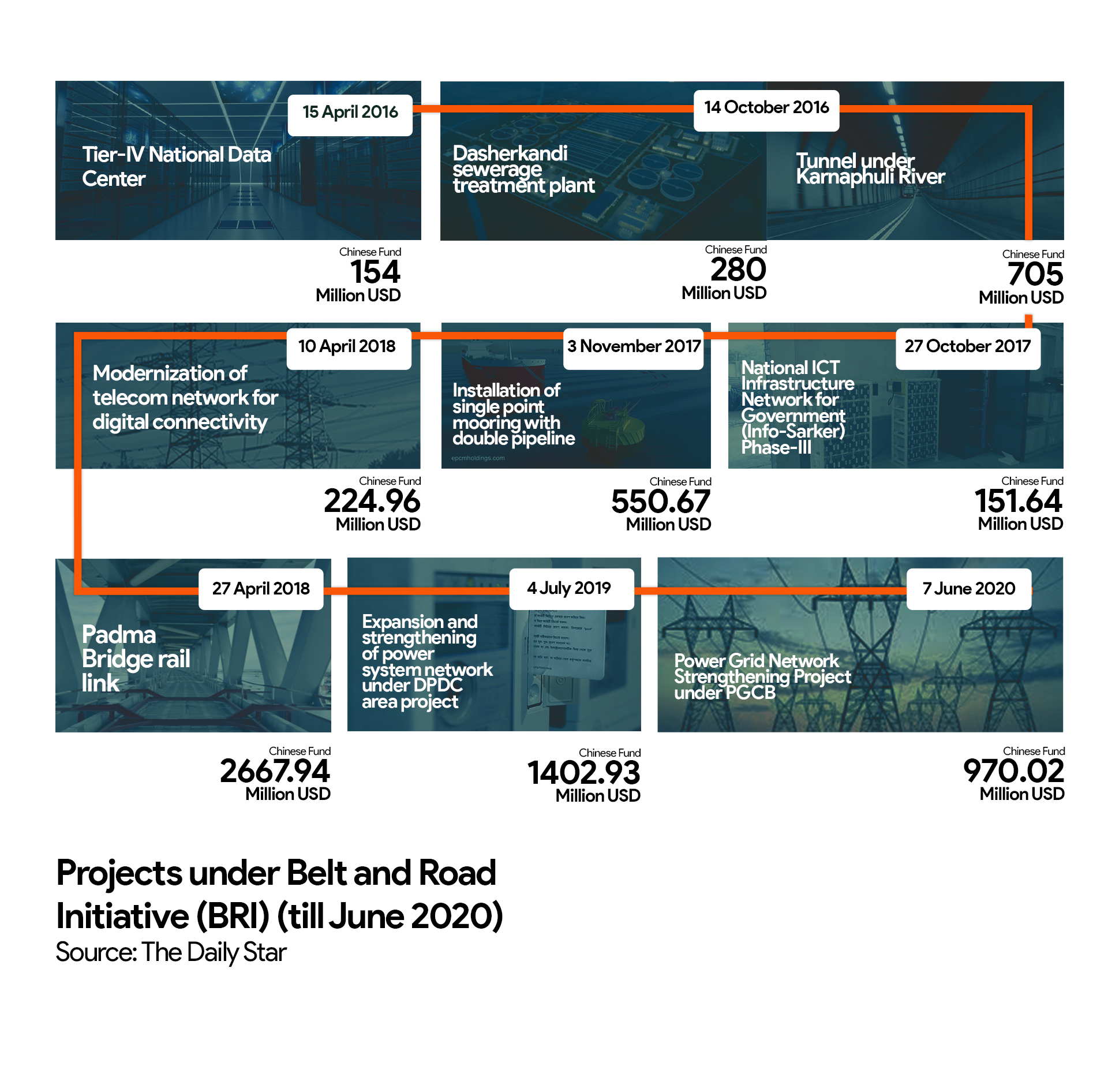
It is predicted that by 2040, Bangladesh will need to invest 1.5% and 1% of its GDP in the power and transport sector respectively.[6] Through the Belt and Road Initiative (BRI) spearheaded by Chinese President Xi Jinping, Bangladesh is able to meet its infrastructure needs in these two areas. BRI is also helping Bangladesh in other areas such as information technology and environmental protection.
Areas for further collaboration between the two countries
Current trends surely testify that the economic relationship between Bangladesh and China is at historic high levels. This relationship can further be strengthened through collaboration between the two parties. Collaboration can be a win-win for both parties. China can tap into Bangladesh’s young workforce and low business costs. While Bangladesh can benefit from Chinese know-how and technology transfer.
Some potential areas where the two countries can work together are:
Smartphone manufacturing
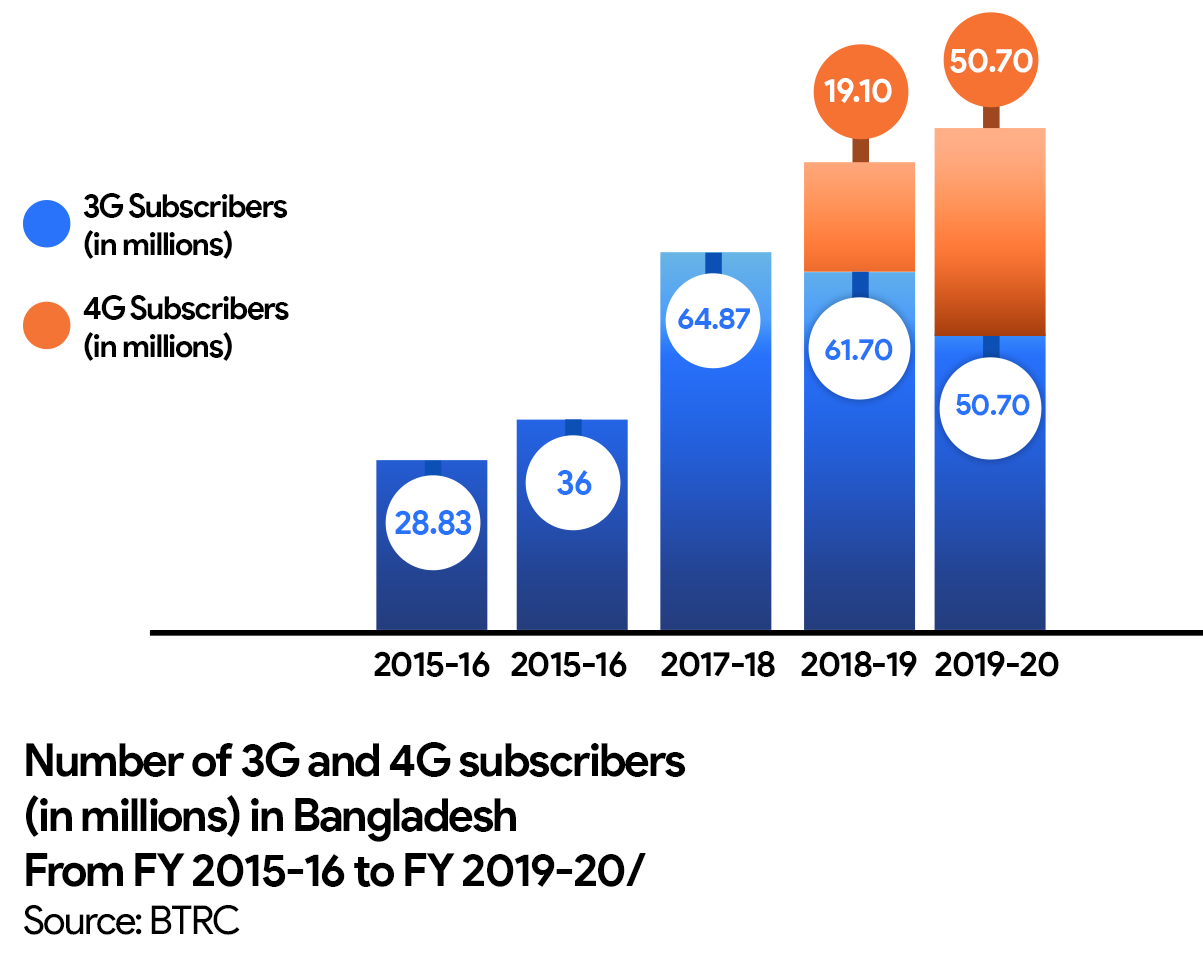
With a young population (Median age of 27 years) and a smartphone penetration of only 40 percent, Bangladesh provides a lucrative market for smartphone manufacturers.[7] The local smartphone market is estimated to be USD 1 billion.[8] More and more consumers are subscribing to 3G and 4G mobile services paving the way for more smartphone adoption.
51 percent of the smartphones in Bangladesh are domestically manufactured while the rest is imported.[9] In the future, locally produced smartphones will come to dominate the market as the government is giving tax reductions of up to 50 percent for the domestic production and assembly of smartphones.[8] Consequently, the government has raised the duties on smartphone imports making it rationale for brands for local manufacture.
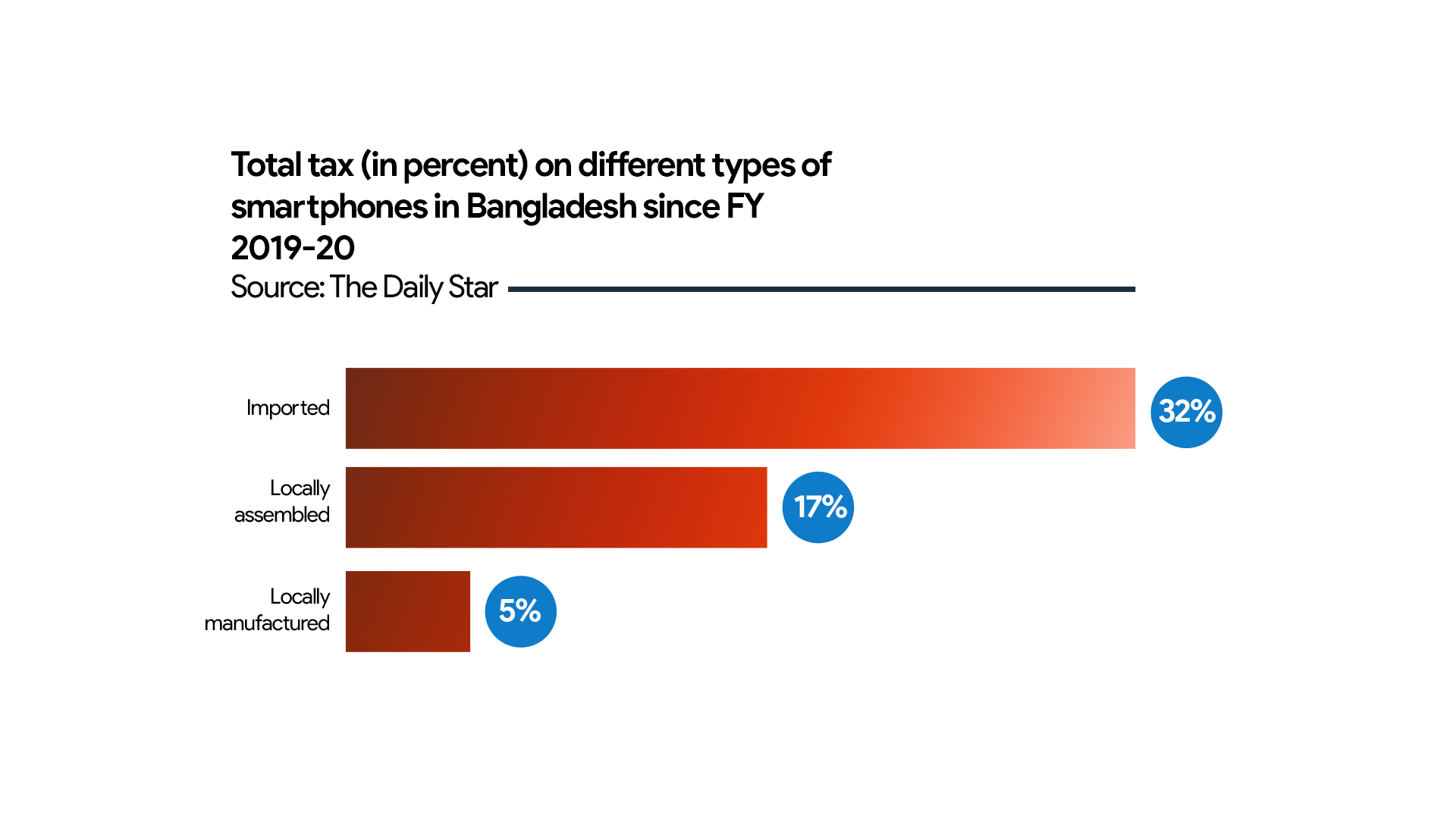
Chinese smartphone manufacturing companies can start production of smartphones in this high potential market taking advantage of the tax reduction and avoiding high import costs. Already Chinese smartphone makers Realme and Vivo have started production in the country. Recently, Realme launched its first smartphone made in the Completely Knocked Down (CKD) process in Bangladesh- Realme C21. International brands such as Nokia and Samsung are also planning to start domestic production of smartphones in the country. Other Chinese smartphone brands such as Xiaomi and Oppo should also consider this opportunity.
Information & Communication Technology
Bangladesh’s ICT industry is expected to grow from USD 1.0 billion in 2017 to USD 4.7 billion in 2025, representing a compound annual growth rate of almost 25%.[10] The country ranks 21st in IT outsourcing, business process outsourcing, and software development. It also has the second-largest number of freelancers worldwide. Contributing to its growth are the young skilled workforce, government initiatives, and low cost of operations.
China is aiming to focus more on technologies such as Internet-of-things, artificial intelligence, and cloud computing as part of its five-year plan. It can tap into Bangladesh’s huge IT workforce in order to achieve that. Huawei is working with the Bangladesh University of Engineering and Technology (BUET) to set up the first ICT Academy in Bangladesh. Other Chinese IT companies can similarly collaborate with Bangladeshi universities and research institutes and conduct training and joint research projects.
Other areas where both nations can work are Ready-Made Garments (RMG), shipbuilding, and renewable energy.
Difficulty in doing business acting as a bottleneck in the relationship
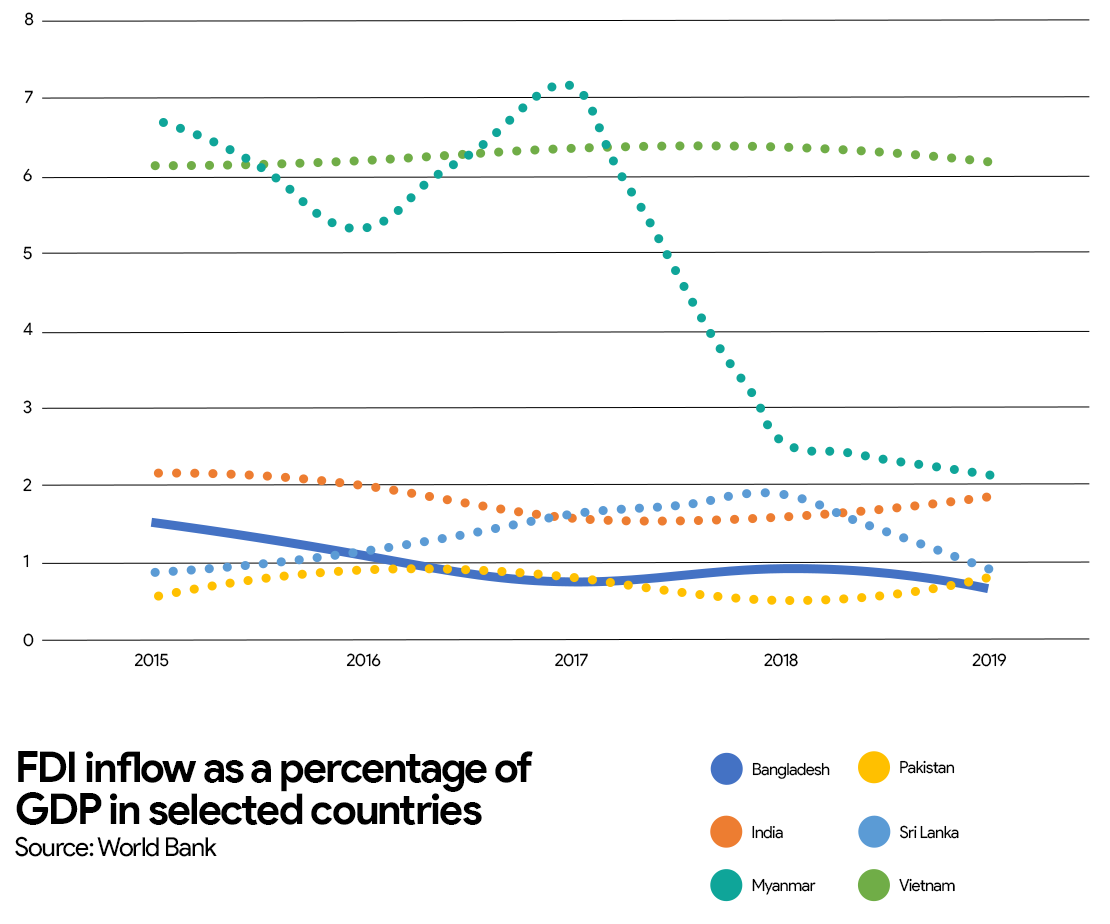
Ranking 168th out of 190 countries, Bangladesh ranks lowest among its peer in the global ease of doing business rankings.[11] The low rankings assert the fact that there are many obstacles to doing business in the country. Thus, Bangladesh often receives less amount FDI as a proportion of its GDP when compared to its regional counterparts. Although Chinese businesses are investing in record amounts, these difficulties in doing business act as obstacles and deter more potential investors.
The government is trying to remove the obstacles in doing business by establishing more Export Processing Zones (EPZ), Special Economic Zones (SEZ), and Economic Zones (EZ). It has already taken the initiative to set up a Special Economic Zone the “Chinese Economic and Industrial Zone (CEIZ)” in Anwara Upazilla of Chattogram. Set upon a land of 774.25 acres, the SEZ is expected to encourage more than 60 Chinese investments and bring investments of more than USD 1 billion.[9] This SEZ, along with other EPZs and EZ will allow businesses to register and begin their operations easily than otherwise.
The road ahead: Balancing economic relationships for sustainable growth
China remains and will remain one of Bangladesh’s largest economic partners. The growth of the world’s second-largest and its fast recovery during the pandemic testifies to its economic prowess. There is much to gain from building a closer relationship with China.
However, Bangladesh needs to be aware of its economic relationship with China. The US-China trade war and China’s conflicts with India mean any deepening of relationship with China will be seen as worrisome by the two countries. Considering the US is Bangladesh’s main export destination and India is Bangladesh’s second-largest import source, Bangladesh needs to balance its economic relationships properly.
Moreover, as COVID-19 has shown reliance on one source can put countries in jeopardy. Therefore, Bangladesh needs to balance its economic relationships with all its economic partners in order to ensure sustainable growth.
References
- Import payments-Top twenty countries- Bangladesh Bank
- China wooes Bangladesh, provides tariff exemption for 97% of exports from Dhaka- Economic Times
- Chinese ambassador: About time Bangladesh, China signed FTA with investment deal- Dhaka Tribune
- Two Chinese firms to invest $28.69m- The Daily Star
- China company to invest $42m in Ishwardi- The Daily Star
- OP-ED: How can Bangladesh benefit from the Belt and Road Initiative?- Dhaka Tribune
- Bangladesh behind Nepal, Pakistan in smartphone use- The Daily Star
- Netherlands - Bangladesh Mapping the ground @ 50 stitching partnerships- The Embassy of Bangladesh to the Netherlands
- BTRC Annual Report 2019-20- Bangladesh Telecommunication Regulatory Commission
- ICT Sector in Bangladesh- Bangladesh Investment Development Authority
- Doing Business 2020: Bangladesh Improves Business Climate, but More Remains to Be Done- World Bank
- China to fast-track construction of its economic zone in Ctg- The Daily Star